Friday, June 15, 2012

Rain Gardens and Storm Water Management in Madison, WI

A Rain Garden along a City of Madison Street takes shape
Rain Gardens are taking hold in Madison, WI. These are often installed by homeowners as a means to prevent rain water from running-off directly into the storm sewers.  The one pictured to the right was part of partnership between the City of Madison and the property owner.  The homeowner and City shared the cost of installation. This one went in last year during major street renovations.  The matting in the foreground was just removed and fresh mulch added to the bottom.

The big brown rectangle in the back is the Rain Garden.  It acts as a small catch basin allowing a recharge of the groundwater.  Madison is surrounded by 4 Lakes and the ensuing rise in the water table means that springs will come back to life.  Rain Gardens also serve as a way to filter out chemicals and debris that would otherwise find their way into the aquifers and lakes. To date, over 498 Rain Gardens have been installed in the City of Madison.

Father and Son Plant their Rain Garden (Photo Courtesy Wisconsin DNR)
So where does the 'Garden' part fit-in? Well, you actually go the next step and put in plants that will flourish in the damp conditions while filtering-out the chemicals.  Some homeowners have opted to create their own Rain Gardens on a smaller scale.  There are so many options and the University of Wisconsin-Extension has put together a free 'How-to' guide. 

It is very easy to get one started.  First of all, kids like to dig in the dirt. Now, you can let the little tikes loose with their shovel and pails and make them part of the solution.  Ahem, some adult supervision is going to be required here.  Seriously, clean water is important today and for future generations.  Involve your kids in the process and let them spread the excitement to their friends when they return to school in the fall.  Fresh water is a critical resource for our nation and we want to ensure that it is available for future Americans.

On a grander scale steps have been taken to stem the flow of storm water run-off into Madison's Lake Wingra.  After years of community involvement with engineers, a storm water retention pond took shape.  Acting much like a Rain Garden, storm water is held and slowly released into the Lake via gravity.  Take a moment to explore the work.  I hope you are inspired to spread the word about Rain Gardens and maybe even build one yourself!


Use the Arrows at the bottom to move around, and highlight boxes to zoom-in on details.

Wednesday, May 23, 2012

Swarm of Bees in Madison Rescued

Well, rescued might be a bit strong but they did find a new home.  Wonderful video showing how Madisonians work together.   In this case a swarm of bees took over a tree branch in Madison, Wisconsin.  True to local character, the property owner and his neighbor call-in Environmentally Correct help.  Two Beekeepers arrive in their Prius, don protective garb and gingerly move the swarm to a bee box. The property owner sacrificed some branches from the tree but we're all better off giving bees a home so that they not only survive, but thrive!


Monday, May 2, 2011

The Final MEIT Blog

The MEIT Program has been one of profound personal and professional growth for myself.   I enrolled in the Master of Education (M.E.) in Instructional Technology at Cardinal Stritch University with the primary goal of being more competitive in my field as a Software Trainer.  Although I have worked with adult learners during my fifteen years as an educator, I wanted to become more well-rounded in a program with K-12 cohorts.  During this time I discovered that many of the adult learning principles are extensions of early education best practices.   There are slight differences but for the most part they mirror one another. 

A big boost to my skill set were the explorations of classroom strategies enhanced with technology and differentiated instruction.  The modifications I made to existing courses to incorporate collaborative technologies and authentic learning were valuable experiences that I will carry forth into my future professional work. 

One of the biggest areas of  growth has been the use of Web 2.0 technologies.  Already proficient with synchronous meeting spaces, the MEIT Program explored the use of wikis, blogs, social media and cloud computing resources.   What a pleasant surprise to find programs like Skype and Tokbox were free for videoconferencing.  I learned to cast aside the notion that anything you get for free can't be any good and embraced Google Docs, Zoho and other Web-hosted applications that did not require a thick-client.  

I did think that the MEIT Program would spend more time on thick-client tools that are still in great use by businesses.  Adobe Captivate, Articulate, Lectora and others are popular tools for creating Elearning modules.  Over time, these products will serve a diminishing market niche as firms transition to Web-based tools.   Thankfully, the MEIT Program focused on the learning strategies and presentation skills independent of any single tool.  It doesn't matter if the tools are in the clouds or located on my hard drive, it's all about the intended outcomes.

As I look back on my blog posts throughout the MEIT Program I can see where I transitioned from 20th Century technologies and strategies to ones that are relevant in the current millennium.   21st Century Skills are the new normal for businesses and education.  Critical thinking, problem-solving and digital literacy along with team/student-centric learning reflect the needs for today's economy.   Interestingly enough, in my own experience the digital natives of today are quite comfortable with new technologies but many lack the depth or strategies to obtain greater value in their use.   In that sense, my skill set has been enhanced not only by cloud-computing Web 2.0 applications but through a deepened understanding of their effective use which I intend to impart to others.

On a final note, I am sad to see the MEIT Program come to an end.  It has challenged my personal views of newer technologies and provided a new perspective on collaborative learning in the 21st Century.  Sure, I was pushed outside of my comfort zone but I came to realize that I was at the forefront of a new approach to learning.  I felt like an early explorer on the verge of a new frontier.  A few people had tread before me, but everything was new and the possibilities, well, limitless!   Am I still a Software Trainer?  No.  I am an eLearning Professional skilled in course design and delivery.  Now, I need to march forward and carry my new skills into my next workplace.

Friday, April 8, 2011

CEDO 599 - Week Two

In the second week of CEDO 599 - Culminating Experience:  Digital Futures, I have the clearance to move forward with my capstone project.  I am building a Website from scratch using the latest version of  Adobe Dreamweaver.  Over the past few months I've been dreaming of building the most fantastic site ever known to The Internet.  My project is to create a Website from scratch using Adobe Dreamweaver.  The Website's intended audience are potential employers and colleagues.  The project will help me gain valuable experience with Website layout, design and coding.  Sure, there were easier ways to go with this but I need the experience to have 'street cred' with technical folks I may work with at a later date.

I completed SMART Objective #1 where I identified all of the content that I will have on my site and placed on my Cardinal Stritch University ePortfolio.  I feel pretty good that I have identified and placed the artifacts on my site. At a later time, when I am doing the actual coding I can go to the source page and grab the artifacts, links and images.  

A the moment, I am working on wrapping-up Objective #2where I create a mock-up or site composition specification. The Digital Storytelling Course and Presentation Zen made a big impression on me.  It was very tempting to start designing the site based on the latest cool features in Dreamweaver.  In other words, start icing the cake before it was baked!  That is a major pitfall and I made myself go offline,think about my intended audience, draw the site by hand, and then create a mock-up in MS-Word.   It feels like there should be more, but that is just the pull of the technology and I am trying so hard  to not obfuscate my site with cool chotchkies and spinning widgets that shine and sparkle.  

Already  I am learning so much.  When I see a great site I let my Web-browser display the source code so I can see how they pulled it off.  It is very exciting to be finally tackle a professional goal I have had for the past few years. 

Saturday, April 2, 2011

CEDO 599 - Week One

The final course in the MEIT Program has started along with my Capstone Project to wrap things up.  I will design a Web-site which will serve as a means to later publish my professional portfolio and establish Brian Adams as a brand in the market. The overall goal of the proposed project is to gain practical experience designing a Web-site using an industry standard tool: Adobe Dreamweaver.  I have never attempted to create a Web-site from scratch and it will require learning new software, designing, developing and publishing the Web-site.  The content will consist of public-facing content which describes myself, my career and exhibits materials while demonstrating technical and design skills which are a 'given' for Internet professionals. 

But why use an 'old school' tool like Dreamweaver when there are tons of Web 2.0 resources for building free Web-sites?  In fact, the MEIT Program has explored so many of these tools it almost seems like I am going backwards by using a thick-client to publish a site.  Well, Web 2.0 tools are widely available but business and educational organizations are still heavily vested in thick-client authoring tools.  The project will deepen my understanding of the underlying technology as well as practical considerations when consulting with Instructional Designers and IT professionals. Students, employers and even myself will benefit as I acquire the skills which permit me to design, develop and integrate educational experiences into existing environments.

Upon further review, the goal is a bit too ambitious for the thirty hour requirement.  Dreamweaver is a tricky tool and underlying CSS and its rules reminds me of my days as a programmer.  I decided to pare down the project so that it would be made-up of three truly SMART goals.  It will have three components:  CSS Template, home page, and three sub-pages with content. The Web-site for the culminating project will act as a shell upon which I will build-out my site following the conclusion of the MEIT Program.

I will use the site to showcase past, current and future accomplishments in my career.  Potential employers and colleagues can view my site at any time to see my work and interests.  RSS Feeds, links to blogs, and examples of ongoing work will ideally support my vision and mission statements.   Beyond the initial scope of the project, creating a Web-site lays the foundation upon which I may better understand the Web 3.0 technology looming on the horizon.   Needless to say, I am going to be very busy the next few weeks as I  kick it into overdrive to meet the goals of this project.

Thursday, March 17, 2011

CED0 565 - Leadership and Planning - Week Six

An Altered Definition of Leadership and Teacher Leaders
The final class of CED0 565 - Leadership and Planning concluded and the course altered my perception of leadership. In the past, I carried a romantic notion of a leader being the strong, rugged individual who could change a system overnight while leading a charge against the old and ushering in a new dawn.  A John Wayne or Steve McQueen making things happen while silently drawing-in others in their wake.  When John Wayne rides out of town, down the dusty trail, will the people keep working to sustain the good that came about?  Not likely as they were never true stakeholders in the change process.  I realize now that I held an idealized view of effective leadership and that it takes individuals working, not in a vacuum, but with others to create, attain and sustain a shared community vision.

I now see Teacher Leaders as blurring the lines between administration and teachers for the good of the students.  Blurring lines, in this case, is a good thing as it leads to better and more effective communication between administration and the teachers who have to generate results.  Teacher Leaders need and should be
 part of the recruiting and hiring process for new staff.  They should also be an integral part of any quality improvement initiatives at a school.  A better fit for the John Wayne analogy, was his role as Sergeant Stryker in The Sands of Iwo Jima. He trained the troops, oversaw their promotions within the ranks, and would never ask them to do anything he wouldn't do himself.  Stryker was tough, fair, and he earned the trust of his mean and they would follow him into battle. Stryker always communicated with the Colonels and Generals above him.  In turn, they respected him and his views and the overall outcomes were more effective.  Sergeant Stryker dies in battle, but he had trained other soldiers to take his place, and they soldiered on.

Leadership Potential

A big shift for me was that all of us have inherent leadership potential.  It takes all types and kinds of people to lead and affect change. Some leaders are wired for an in-your-face approach while others take time to sow seeds that raise awareness and create a groundswell for change.  While the more boisterous and brash individuals may  rub people the wrong way, they provide an opportunity to crack open topics and question why things are the way they are.  I see that I have been a leader and have even greater leadership potential in the future.  Unlocking that potential means utilizing the feedback from my leadership surveys to become a more effective leader.

In society, professionals such as doctors, lawyers and businessmen provide avenues for leadership in their practice and communities.  One would hope that good leadership is about raising the social good for as many in our society.  Teachers really are leaders in the shaping of young minds so that they may grow-up to be reflective and positive contributors to society.  Perhaps this seems like a Utopian view of leadership, but I have seen good things happen when good people apply themselves to seemingly hopeless tasks. 


Improving Education from Within

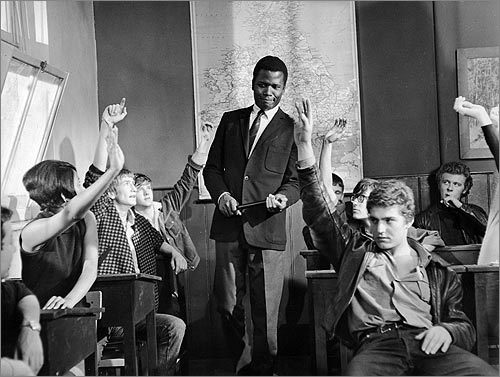
Since I am on a Hollywood theme, one of my favorite movies is To Sir, With Love.  The story stars Sidney Poitier as an engineer from the British West Indies who takes a teaching job at a tough, low-income school in London is quite powerful.  The older teachers are burnt-out, the younger ones are fearful of the students, and the students see no reason why they even need to be at the school at all.  Poitier's character has an epiphany and sets about changing the overall learning environment, or culture, at the school.  Poitier leads by example.  The change is rough, has its low points, but the school and students are better for it in the end.

I have always been moved by To Sir, With Love.  In the end, he finds his true calling as a teacher to students and as an exemplar to his peers and administration.  I can think of no finer depiction of a Teacher Leader who can and does change the system from within.  Yes, I believe that all of us can change the system or organization that employs us.  It takes effort, deliberate action, making time for others and raising awareness. And, while we walk the walk, show patience and understanding for those that are slow to come around.  In the end, they rise and join with the others.

Friday, March 11, 2011

CEDO 565 - Leadership and Planning - Week Five

Making Change Happen

The past week we completed the Change Game simulation and reflected as a group on what activities helped foster change in a system.  I also completed an assignment where I examined how change occurs in my organization.  When it comes to making change happen one has to do a lot of talking.  An e-mail, like a message in a bottle, may not reach the right audience.  Plus, it does not convey the same meaning as a good conversation where ideas are shared, connections are made and awareness of issues/challenges emerges.
 
Looking back at the Change Game simulation and my own personal experience with system wide change, understanding the overall system and interrelationships is critical to affect and sustain continuous change. It is not enough to create a coalition.  One needs to get system or organizational buy-in from all of the stakeholders.  Not everyone will embrace change or system improvement initiatives, but they do come around eventually.  Identify who the key influencers are in each part of the system and sound them out.  How do they feel?  What are their concerns about change?  Bottom line:  keep talking to everyone and asking questions.

Awareness of a need for change is always the first step and one that can not be skipped over. Be patient, have conversations, listen and reflect.  Things may not happen as fast as we like, but trust the system, and trust the people around you to see opportunities for improvement.

Friday, March 4, 2011

CEDO 565 - Leadership and Planning - Week Four

Orchestrating Change

The week has been filled with activities, readings and surveys where we think about how to affect continuous, effective change.  Chapter 5 of Gabriel's How to Thrive as a Teacher Leader explores improving environment, climate and morale to rally an organization around sustained quality improvement initiatives.  If either of these are poor then change will meet resistance.  In an earlier post I brought-up the 'Ready, Fire, Aim' approach which seldom works.  To solve problems one needs to conduct in-depth data-analysis, reflect on causation and gather input from all of the stakeholders.

It takes the entire system and its component parts motivated and pulling together towards the goal(s).  A leader should examine how change will impact all of the domains within a system and formulate an action plan which is realistic and allows for flexibility during implementation.  Many a battle plan is cast aside once the fighting begins. If the system is behind the cause and domains understand the end game, then forces can be realigned in the field to achieve objectives.


Many leaders enter an organization and attempt to make change without careful root cause analysis of underlying problems.  In our readings from McREL, data analysis and stakeholder reflection are necessary to understand where the system is today before establishing action plans.  Once a vision is established, and corresponding mission statements, the specifics for how to bring about enduring change can be implemented.

This past Monday our Study Group played the Change Game simulation for a fictitious school.  The goal was to bring about as many benefits to the school using what we knew about the various school personalities and specific activities.  Each activity cost a specific number of resources and they could never be recouped or won back.  Energy out was just that - energy out.  Well, our group did not do so well.  I think if we had taken the time to review the school personalities and had conducted our data analysis and system reflection first we might have garnered greater benefits for the school.

The simulation was a valuable lesson in that it parallels how institutional change is attempted by many leaders.  CEOs, Team Leads and Principals can fall into a trap where they feel that the mandate given by their superiors requires them to do it all.  Effective and continuous change, especially a change in the culture, is best served when all of the system components pull together in common purpose.   Team and team inter-relationships need to be healthy and professional. The leader, instead of trying to play every role, acts as the conductor leading an orchestra.  They understand the interplay between all components and helps them work together to create beautiful sounds that do not detract but complement the actions of one another.

Thursday, February 24, 2011

CEDO 565 - Leadership and Planning - Week Three

The theme this week in CEDO 565 is change.  If you think about it, change is happening all the time.  But how do we as individuals and leaders react to change?  The class had a good time viewing and reflecting on the parable 'Who Stole My Cheese?'.  The cheese represents the things that nourish us in life.  The cheese may be a job which provides income or something we want or need to have. One can become complacent and imagine that things will always stay the same, but they never do, but change happens.

How well an organization plans for change depends on its corporate culture.  If a business continually seeks-out new markets and tries new ventures, then it might be successful some of the time.  That's right, some of the time. New opportunities are often hidden inside a maze.  It takes teams, comprised of diverse personalities and life experiences, working together to expand organizational interests. Marketing, Sales, Research and Development working in unison to find rich, new niches.  Businesses that continue to produce the same product, services and solutions will continue to do the same until there is no more customer demand and they find that they are, surprise, out of business.

A few years back I worked for Packaging Corporation of America (PCA).  The new CEO, Monte Hayman,  had just started and reviewed the rather flat sales and asked the executives in a meeting, 'What business are we in?'  Can you imagine the funny looks that were exchanged by the older executives as they pondered this obvious question from the new, and no doubt inexperienced, CEO?  Every single one said, 'We make corrugated cardboard for boxes'.  Monte Hayman stood in front of them and said, 'Wrong!  We are in the Packaging Industry'.  Monte directed the executives to seek-out new opportunities that went beyond manufacture of container board.  Within a year PCA had acquired 12 molded fibre plants (think egg cartons) and several plastic packaging plants.

In just 2 years PCA doubled sales from one to two billion dollars. The 1990's saw clear plastic food packaging become the new normal.  Today, supermarkets sell prepared foods in plastic containers and molded fibre egg cartons constitute half the selection in the Dairy Case.  And how are these items shipped in bulk to stores?  Why they arrive in heavy corrugated cardboard boxes also manufactured by PCA. 

I tell this story because it captures the essence of what this past week has been about in our course:  Leadership and Change.  At PCA the old guard was complacent with flat sales and doing business the way they always had.  The new CEO transformed the corporate culture by helping them see opportunities beyond the doors of their manufacturing plants.  The resources of a sleeping giant awoke and went to work researching and acquiring capital investments that enhanced PCA's market share in the Packaging Industry.  It was an exciting time to work at PCA but not all of the employees were thrilled.  Many were happy with the old ways while others were empowered and eager to tackle new challenges.  When it comes to change some will always resist while others embrace it.  Thanks to good leadership, PCA not only survived---it thrived.

Friday, February 18, 2011

CEDO565 - Leadership and Planning - Week Two

Ready, Fire, Aim. 

It is a historic time in Wisconsin and America as Teachers, Firefighters, AFSCME, other Unions and everyday people of all ages and class descended upon the State Capitol to let their voices be heard.  But what does this have to do with the MEIT Program?  Well, studies this week have the cohorts examining school and school district data for performance analysis.  If school policy and programs are merely symbolic and do not address root cause problems then the leadership is poor. Students and parents, in such a case, deserve better leadership and, as constituents, have a right to protest and demand competent stewardship.

An assigned reading compares the Traditional and Data-Driven Decision Making approaches in schools.  The Traditional Model involved a lot of guess work and symbolic approaches to school improvement.  The Data-Driven Model focuses on specifics and informs decision making. 

Earlier in the MEIT Program we used WINNS to gather data on how well schools were doing in terms of student performance.  Once again we returned to WINSS to evaluate group and sub-groups in the schools and school district.  The available data lets one see how well students are doing within their school, school district, and school districts across the state.  Careful examination of data informs decision making so that planning and resources address specific performance improvement goals.  Rather than blindly lead some symbolic charge or vilify a group, use of data permits school administrators, Teacher Leaders and parents to identify and tackle the real problem areas. 
The Mother is a  Parent Volunteer at her daughter's school

Thursday, February 10, 2011

CEDO565 - Leadership and Planning - Week One

The new course, CEDO565 - Technology Leadership and Planning, got rolling right away as we examine the qualities of good leaders.  A theme from a TED Video we watched is that good leaders are the result of education and their values.   Patrick Awuah from Ghana described how poor leadership characterized by corruption and a sense of entitlement hurt the people and the economy of his country.  Awuah elaborates that leaders are not just found in government but are in the elite class of professionals.
 

So what makes for 'Good Leadership'?  What are the attributes of good leaders?  In small groups and through individual activities I explored these qualities.  The journey continued as I completed several self-assessments and reflected on my own personal leadership traits and 'virtues'.  I found that I am empathetic, humble and that I am a good 'Life Coach' when it comes to helping others reach their potential.   I am also big on details, possess a strong work ethic and have a creative side.   Keeping that in mind, would all of these traits be a good fit for any and all organizations?

OK, I haven't discussed Leadership Frames so let me clue you in.  To be an agent of change, a good leader should understand the organizational framework. The four frames are:  Political, Symbolic, Structural, and Human Resources.  
  • Political, as the name implies, is one with groups that have opposing or divergent goals. Resources may be scarce and their allocation is contentious.  Conflict is inherent in such a scheme and requires compromise with ongoing jockeying to keep the constituents pulling towards common goals. 
  • Symbolic organizations use rituals and company events to impart vision and inspire individuals and teams to work towards a goal that is not yet quite clear or readily apparent in day-to-day endeavors. 
  • Structural is where roles of individuals and teams are well-defined. The component elements have clear purpose and there is little to no ambiguity in what each entity contributes to the organization as a whole. 
  • Human Resources focuses on empowering the individuals within the organization.  Given the Lean/Agile business models of the 21st Century, companies seek change and innovation by distributing power to teams and team leads. 

In hindsight, I wish that I had known about organizational frames before I graduated from college.  I look back on the companies I have worked for and I see how they directly fit or contain a blend of these frames.   The challenge for myself is to review my leadership traits and virtues from the self-assessments and realize my personal strengths and limitations when working for any organization.  I now have a valuable way to evaluate organizational structures along with my own predilections so that I am more valuable and effective for any employer.

    Friday, January 21, 2011

    CED0 555 - Professional Portfolio Experience - Blog #3

    Happy New Year and welcome to the 2011 edition of Adventures in E-Learning.  CEDO 555 Professional Portfolio Experience concludes at the end of the month and I find that I have been reflecting on the MEIT Program.  No, I am not daydreaming.  CEDO 555 required that I pull together course reflections and supporting evidence of my work.  Thankfully, this very blog helped me go back in time and recapture the experiences and assignments completed.

    Looking Back

    From CEDO 501 to CEDO 555 I needed to find an artifact which exemplified the course and demonstrated professional growth.  Looking back at my original Social Bookmarking Assignment in 501 Succeeding in Online Learning I seemed so naive.  In the introductory course I had my first experience using Google Docs after years of using MS-Office.  Over the next few months experience and proficiency with online Web 2.0 tools such as Zoho and SlideSix came to pass.  My Digital Portfolio is contained on Google Sites and I used the HTML tool to embed several artifacts for easy viewing.  I have a come a long way from the early days and fumbling with online word processing applications.

    The computer I used at the onset of the program has been replaced with my 'Dream Computer' as configured in the CEDO 510 Computer Systems and How they Work.  Tip of the day:  if you configure the same system on Dell.Com and keep saving it, they give-up and send you a coupon.  I received one from Dell for 45% off  and I used other e-coupons to knock the price down even further.  And since I'm handing-out free advice, get a surge protector with battery backup!

    Well, the MEIT Program to date can not be covered in a single blog.  I am pleased with my Digital Portfolio and it will provide a more exhaustive and detailed redux of each course.  But now I must look forward and plan a culminating project which challenges and extends my learning.

    Culminating Project

    Background:

    I spent a half day at Operation FreshStart and enjoyed meeting the counselors and teachers.  Sadly, their needs are more basic and technology skills are not on the critical path.  Still, I met new people and look forward to volunteering time to help them with at-risk youth. I thought about my fallback position for work with the Hoofer Sailing Club.  But, where is the challenge since I already created a wiki for them last summer?  I decided that I need to truly challenge myself by building a Web-site from scratch. 

    Engineering and Architecture:

    Throughout my professional career I have dabbled and patched-up HTML, authored a few Web pages but never have I built a Web-site from the ground up.  Frank Lloyd Wright was a visionary architect who tipped the world on its side with buildings that defied established norms and heightened the felt experience of enveloped space.  Wright, to this day, is seen as a great architect but what is seldom understood is that he had a firm grasp of engineering materials.  Cantilevering, as seen in Falling Water,  and the open space of the Johnson Wax Headquarters were all made possible by technological advances in building materials.  Wright understood the technological limits and pushed his creations to the edge.  By the same token, I need to understand the engineering that goes into Web-site creation so that I employ and extend the technology to its greatest use.

    Rounding-out my technology tools:

    As a professional I need to be able to build a Web-site without relying on free sites that also populate screen real estate with advertisements. Adobe Dreamweaver using Cascading Style Sheets (CSS) along with tools such as Photoshop and Flash are widely used by site developers.  The Adobe Suite of products has great market penetration in business and education and many organizations rely solely on the Adobe tools.  Working with them will help me see new possibilities for extending their use in education.  I have been spoiled with all of the free Web 2.0 applications but I am leery of their sustainability in the long run.  To be quite 'frank', the business models rely on advertisers and the gleaning of marketing information and this is of great concern for many organizations.  If it seems too good to be true, then what is the catch going to be? 

    Students, employers and even myself will benefit as I acquire the skills which permit me to design and develop educational experiences that are not tied to applications which may or may not be available from one year to the next.   So, excuse me while I roll-up my sleeves and get to work building a Web-site.  The first one may not be a work of architecture, but even Frank Lloyd Wright had to start somewhere.

    Friday, December 17, 2010

    CEDO555 - Portfolio - Week Two

    This past week has been an incredibly hard one for me involving a lot of soul-searching about my professional goals.  Our main assignments this past week have been to create Vision/Mission statements and come-up with ideas for a culminating experience project.  Looking back at my first blog post, my heart still tells me that I need to make a difference with my life and education.  The economic and digital divides have never been more apparent than today.  The enlightened goals of virtual charter schools to serve inner-city and rural youth are lofty but in practice they seem to just enhance those who are better off in our society.

    My first vision and mission statements had a split focus between corporate learning and public education.  I spent 4 days crafting statements that would catch both worlds, yet, I felt empty.  What is in my heart?  What is my passion?  What is it that I really want to do?  I decided that I need to put forth effort and challenge myself to help improve the lot of others.

    Vision - Equitable education for all students that fosters  21st century skills through authentic experiences utilizing eLearning and blended delivery formats.

    Mission:  Overcome the educational and digital divides by using elearning and Internet technologies while employing teaching best practices to create equitable education for all students. 
    • Design courses which engage students to bring their unique life experiences to bear on authentic problems.
    • Create collaborative training solutions that are authentic and relevant to students.
    • Utilize online, face-to-face and blended course delivery formats to maximize and achieve the best possible learning outcomes.
    • Employ existing or emerging Internet technologies which promote learning outcomes  and deepen understanding for participants.
    • Incite students' love for lifelong learning by encouraging and rewarding divergent thinking. 

      The culminating experience project proposal that I put forth needs to be something that stretches and challenges me in new ways while utilizing new skills from the MEIT program.  Over the past year I have helped bring technology and digital resources to the UW Hoofer Sailing Club.  I piloted a wiki several courses ago and it helped prototype what an actual Club resource could look like.  Since then, the University of Wisconsin enabled wiki-like functionality but it has yet to be implemented.  Could be a good culminating project for Brian!  Then again, aren't I really just helping the economically-advantaged and privileged?  But what about helping those who really need a hand?

      I came across a non-profit organization called Operation Fresh Start which helps school drop-outs and early offenders get their GED while they build houses in the Madison area.  I contacted them and asked if they might like to discuss how to help their participants practice and acquire 21st century technology and Internet skills.  I offered my services and I hope that I can do something with this organization and help young people improve themselves while getting their diplomas.  My heart and head is excited at the prospect of doing some good and making a real difference.

        Friday, December 10, 2010

        CEDO 555 - Portfolio - Week One

        Well readers, hard to believe but Brian is now running downhill towards the finish of his Master's of Education in Instructional Technology at Cardinal Stritch University.  The time has come for me to put together a Digital Portfolio describing my courses, evidence of work and how it relates to teaching standards.  The last bit caused a lot of consternation on my part as I am not a public school teacher.  I thought about creating a Career Portfolio for potential employers and job reviews but I do want to document how my coursework and activities mesh with teaching standards.  At a later date I may want to pursue a teaching license and the MEIT Portfolio will help me prove that I have met some of the requirements.

        I took a look at over 15 portfolio sites this week including those suggested by my study team.  It was really hard to find one single portfolio that did it all for me.  Some were quite technical and hard to read while  others were cluttered with widgets and background templates that detracted from the author's message.  I think back to Presentation Zen by Garr Reynolds and the ones that were most appealing had a simple yet clear design to them.  Solid backgrounds, easy navigation and a minimalist approach where less was more.

        There were 2 sites that really stood-out for me in my quest for the ideal.  Although both do not meet all of my requirements I feel that they have qualities worthy of emulation.  Bruce Richards is an Instructional Designer. Bruce’s site is free of clutter and when one selects a heading from the navigation pane it gently scrolls to the appropriate section. If you browse through Bruce Richards site one gets a sense of what he’s about, educational experience and approach to his work.  
         
        Dr. Roland Bolender's  site contains so much information but it is cleanly laid-out in a way that it is not overwhelming.  From the Mission Statement and Role as a Teacher one can easily navigate to the resume, awards, curriculum and other headers.  Dr. Bolender’s site contains a full list of curriculum, online classes taught and evaluations. Overall, I like the design and how Dr. Bolender substantiatesof his work with specific detail that demonstrate a prolific career as an educator.

        I have a better idea now of the design and layout I will use for my MEIT Portfolio.  The CEDO555 course requires us to use Google Sites from our student Wolfmail account.  I browsed various templates and selected a format.  Now, all I need to do is figure-out what my content will be and how to organize it using Google Sites.  Ah, yet another Web 2.0 application to master.  The MEIT program has had me use so many that it's a good thing I'll be listing them in a portfolio so I don't forget!. 

        Thursday, December 2, 2010

        CEDO 550 - Week 6

        The final week of comes to a close on CEDO 550 aka Online Facilitation: Taming the World of Online Learning.  The course has been challenging in so many ways but mainly that it has helped me wrap my head around specific strategies and best practices for online learning.  The course has provided insights into how Virtual Charter schools are changing the educational landscape in Wisconsin.  No longer the wave of the future, the online learning Tsunami has already washed over the state and all of the stakeholders in education have to adapt - sink or swim.

        Although my teaching up until this time has been mainly with adult learners, my trainees are gaining 21st century skills by utilizing the office automation and collaborative technologies  all around them.  My role as a company trainer shifts to being one of a learning facilitator.  I still create courses but my instructional design plans for employee-to-employee interaction.  Company wiki, discussion boards open to the client community and rapid prototyping of products and services using brain storming sessions.  The 21st century skills our schools foster in young students are just what the business world uses today.   Funny, but calling myself a 'Trainer' sounds so regimented.  I have become an eLearning and Collaborative Technology Professional.  

        I understand the Virtual Schools Legislation in Wisconsin and am concerned/excited about the impact it will have on local control of curriculum.  Virtual schools are licensing online curriculum from third parties.  Although textbooks have come to be dominated by other states, it is likely that as online learning matures that 1 or 2 big players will emerge dominating online curriculum. Economics dictate that as the industry matures, it will become less competitive and products will be less innovative and responsive to customer needs. 

        The Madison Metropolitan School District's  involvement in online learning includes the Madison Virtual Campus (MVC)  and participation in the Wisconsin eSchool Network.   MMSD offers  11 categories with 115 courses for students which can be found in the online MVC Student Online Course Listing.  Breaking it down further one can see the distribution of courses by category.


        I spoke with 2 Madison MSD teachers and they were amazed at the number of online offerings for students.  I looked at the MMSD Technology Plan and they intend to expand online learning opportunities for both students and teachers.


        During the module I was excited to learn about the current offerings of online learning in my school district.  The Madison Metropolitan School District (MMSD) offers 3 different portals for special content in addition to participation in the Wisconsin e-School Network.   If you were to ask most parents with children or teachers in Madison about these offerings they would not have a clue.  That being said, my examination this week of the MMSD's current and future use of online learning has been most enlightening.  I have a better sense of what is happening in my own backyard and it will be fascinating to see how online learning progresses in the coming years.

        Friday, November 26, 2010

        CEDO 550 Week 5

        This week in As the CEDO 550 Turns has been a busy one.  The course is one semester's worth of work packed into 6 weeks.  Now I understand what is truly meant by an accelerated Master's Program.   I have been examining online tools and spent some time looking at a poplar LMS called Moodle.  Moodle is short for Modular Object Oriented Dynamic Learning Environment and it is designed to support a social constructivist framework for education.  Moodle appears to be appropriate for most online learning strategies but it lacks a synchronous classroom component.  Not a problem, I could always link-in Elluminate or another platform to fill the need. 

        My experience with online communities includes the launch of Lithium at Pharmacy OneSource, wikis, and social media sites like Facebook and Linked-In.  All online communities require active participation if members are to find it interesting or valuable.  In our MEIT program we use discussion boards to post topics and review ensuing posts from cohorts.   My personal learning is enriched with the immediate feedback and the diversity of opinion that results from these asynchronous posts.  Linked-in allows me to network with professional groups, read about new jobs and participate in discussions.  The latter provide insights into what is currently happening in the job market and focuses my efforts in my career field. 

        I believe the biggest benefit of collaborative groups is that it creates an opportunity where the depth and breadth of individual experience is brought to bear on a common problem.    In the MEIT program I often meet with cohorts on a collaborative project.   In our team  we define the project scope and move forward eliciting comments and discussion from everyone.  I never cease to be amazed at the different views and insights individuals share or add to a discussion.   Sure, I have 'my take' on things - but is that the right one?  I feel reassured that my group finds a consensus and we are able to explore the project and together create a viable product we can all feel good about. 

        I believe the greatest challenge for collaborative groups in business is that it requires a corporate culture that supports group vs. individual competition.   Teams take on greater responsibility and authority for solving problems while creating improved products and services.   Traditional management roles have to change so that managers and supervisors become team facilitators.   I recently worked within the Agile model of software development and it was a breath of fresh air.  The multidisciplinary teams consisting of software developers, quality assurance and technical liaisons helped the company roll-out better product in a shorter amount of time than traditional approaches.  But, it took a brand new Chief Technology Officer driving the culture shift from the top-down to foster the collaborative vs. cooperative environment. 

        My thoughts regarding the social development and socialization issues are unsettled at this time.   Online schools rely on student-centric curriculum involving heavy interaction between teachers, peers and parents.  Online schools further learning outcomes and foster 21st century skills through planned collaborative activities.  Social interactions are planned and are the basis for much student learning.  In the online world, students can open-up to their peers without regard to race, creed, color or economic status.  However, the study we looked at showed the importance of extracurricular activities on online students.   

        Online learning does refine remote social skills but it still takes physical interactions to create a well-rounded, socially adept and effective individual.   Do 2 or more kids meet on a playground or basketball court and text each other and reflect on the comments?  Well, it may look that way these days but it is important that social skills furthered in the online environment support face-to-face interactions that people will have with future employers and colleagues.